2nd Battalion, 12th Infantry Regiment Making Large Strides in Kunar
Combined Joint Task Force
Story by Staff Sgt. Gary Witte
Date:
03.21.2010
Posted:
03.21.2010 09:40
KUNAR PROVINCE, Afghanistan – It was quiet for about a week after the 2nd
Battalion, 12th Infantry Regiment, Task Force Lethal, of the 4th Brigade Combat
Team, 4th Infantry Division, took over responsibility for the Pech River valley
in Afghanistan's Kunar province in June 2009.
"After that, it was kind of intense," said U.S. Army Maj. Ukiah C. Senti, the
battalion executive officer.
The attacks began – a daily diet of aggression against Afghan national security
forces and International Security Assistance Forces that included small-arms
fire, heavy weapons, indirect fire, rocket-propelled grenades and improvised
explosive devices.
Nearly a year later, the violence has lessened, and some locals once known for
their hostility towards the government now deal with its representatives
regularly.
To achieve this drop in violence, the battalion took an interesting approach.
Instead of using pure combat force to achieve their goals, the units used
unconventional tactics, like sitting down to chai tea and snacks with village
elders.
Reaching for higher ground
Task Force Lethal Warrior covers an estimated 1,000 square kilometers of
operational area with 11 forward operating bases, combat outposts and
observation posts.
From the farmlands of the Watapor valley to the wooded Korengal valley, the
concept of high ground depends on where you stand. The region's main travel
routes are overshadowed everywhere by peaks and acres of mountainsides.
The battalion itself comes from Fort Carson, Colo., where the mountainous
terrain mirrors that of the eastern Afghanistan territory the unit now patrols –
chiefly the Kunar province.
Many Soldiers comment on the impressive landscape, even though they regularly
face steep climbs up inclines while weighed down with about 50 pounds of body
armor, weapons and ammunition.
Senti, who is from Taos, N.M., said when the battalion started its work here,
most of their efforts were focused on the kinetic operations. Then about a month
in, the unit began holding more meetings with village elders.
"[The elders] were probably the most helpful element of the whole process," he
said.
During these discussions, village leaders helped the battalion narrow down the
areas where the attacks were coming from – the "seams" of terrain where
insurgent forces lurked.
By targeting these seams – on both high ground and low – the battalion and ANSF
have sought to reduce civilian casualties. By disrupting enemy operations, it
helped reduce the insurgents' influence over the communities, Senti said.
U.S. Army Staff Sgt. James M. Combs, of Midland, Texas, a squad leader with 1st
Platoon, Company A, said the more the unit visits certain villages, the more
accommodating the residents become.
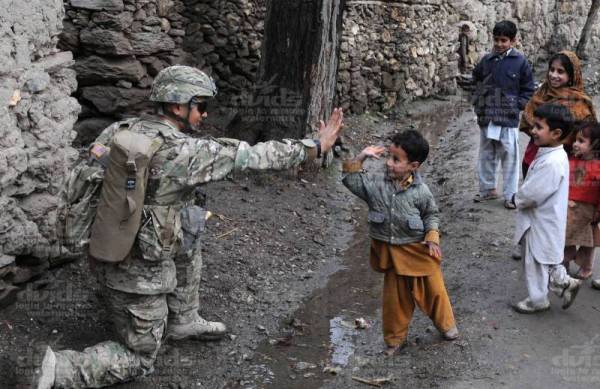
"That's the first indicator," Combs said. "When the kids like you, the adults
start to come around."
Growing developments
According to Senti, the battalion is currently spending about 70 percent of its
time on stability operations. These efforts range from new fruit orchards to
development councils, and have become key in the struggle for peace in the
region.
Where the unit used to simply ask residents about the projects they needed, then
managed the process through contractors, now village representatives work with
Afghan government officials to make developments happen.
U.S. Army Capt. Edward Y. Park of Orlando, Fla., a team leader with the 405th
Civil Affairs Battalion, said the goal is to empower the Afghan officials, known
as line directors, who work with village leaders.
"We want the people to be seeing their line directors, not us," he said.
Each village has a Community Development Council, which in turn appoints a
representative to a District Development Assembly, Park said.
The assembly is not just responsible for identifying needs for the community. It
also requests local bids from contractors, and then provides both quality
assurance and quality control, ensuring the work is also done by locals.
While the assembly still uses the Commander's Emergency Relief Program as a
budget for its projects, officials expect this money will eventually be replaced
by funds from the Afghan government.
Getting villagers to participate has been one of the challenges. U.S. Soldiers
continue to meet with elders throughout the area's many valleys and encourage
them to take part in the weekly assembly meetings.
U.S. Army 2nd Lt. Florent A. Groberg, of Supply, N.C., the platoon leader for
4th Platoon, Company D, said he wants to bring as many villages into the process
as possible.
"It's our job to let them know what's going on and get them involved," Groberg
said. "That's the only way we can be successful in our mission."
In turn, the battalion created Development Support Teams last year to help
mentor line directors and other Afghan officials on the law and other issues.
One indicator of progress came in November, when the battalion began seeing
tribe members from the Korengal Valley – traditionally an area of severe
resistance – coming to talk to the district governor about projects on a regular
basis.
"The fact that they're there is a huge success for us," said Maj. Chris T. Owen,
of Austin, Texas, the training and operations officer for the battalion.
High costs
Through mid-March, the battalion has lost eight U.S. Soldiers from various
attacks throughout the area of operations. Their photos and identification tags
line the main hallway of the battalion headquarters.
Senti said losing their comrades has been hard, but their ultimate sacrifice
would not be in vain.
"I think the number one thing is, how can we do better next time to prevent this
from happening in the future?" he said.
Combs, who knew three of the eight fallen Soldiers and has previously served
tours of duty in Iraq, paused as he tried to talk about the losses. He said some
Soldiers wear bracelets engraved with the names of their friends.
"It's still a touchy subject," he said. "You just kind of grab it, accept it,
pick it up and take it with you. We've still got our missions."
Fatalities and injuries haven't been limited to U.S. troops. In February, Lt.
Col. Aziullah, the commander of the Afghan national army's 3rd Kandak was killed
in an 82 mm mortar attack on FOB Blessing. Afghan national police officers as
well as private contractors have also been killed in the violence.
Senti said there have been several cases where Afghan security guards were
pulled from vehicles and murdered when they were traveling to visit their homes.
"Across the board, obviously, people have given blood," he said.
Long-term solutions
Although there have been attempts, militants have not been able to overrun an
ISAF post in the area during the past year.
They even tried to overrun the Chapa Dara District center in February, before
being beaten back by ISAF and ANSF.
Last summer, intelligence pointed to a massive attack aimed at FOB Blessing,
Senti said. Using the radio station on base, the Afghan officials were able to
talk to the public about the rumors and the attack never materialized.
"It allowed us to beat it without firing a shot," Senti said.
The radio station enables residents to call in information about potential
attacks and helps ISAF and ANSF disseminate facts to the public. This includes
the cost of community projects, which helps make the process more transparent.
Other efforts to reach the public have taken more tangible form. The unit has
arranged the planting of 20 orchards of fruit trees as well as a forestry effort
to prevent soil erosion along the rivers. Both projects are expected to be
complete by time the battalion leaves.
"The concept of rich and poor here are completely different," Senti said, noting
how money means less to the Afghans than tangible goods that can be traded or
used.
The fruit trees, which include five orchards planted by previous units, can
eventually become a source of economic strength for the communities, he noted.
"All the economic functions of any of the stability operations we do, really,
you have to look at it long-term," Senti said. "You get continuity between
units, so development stays the focus."
Combs said at his level he's seen improvements and progress. Instead of Soldiers
having to fight blind, residents call in tips and information. A rapport has
developed between the battalion, the Afghan forces and many villages.
The battalion has made headway in the region, Combs said.
Images
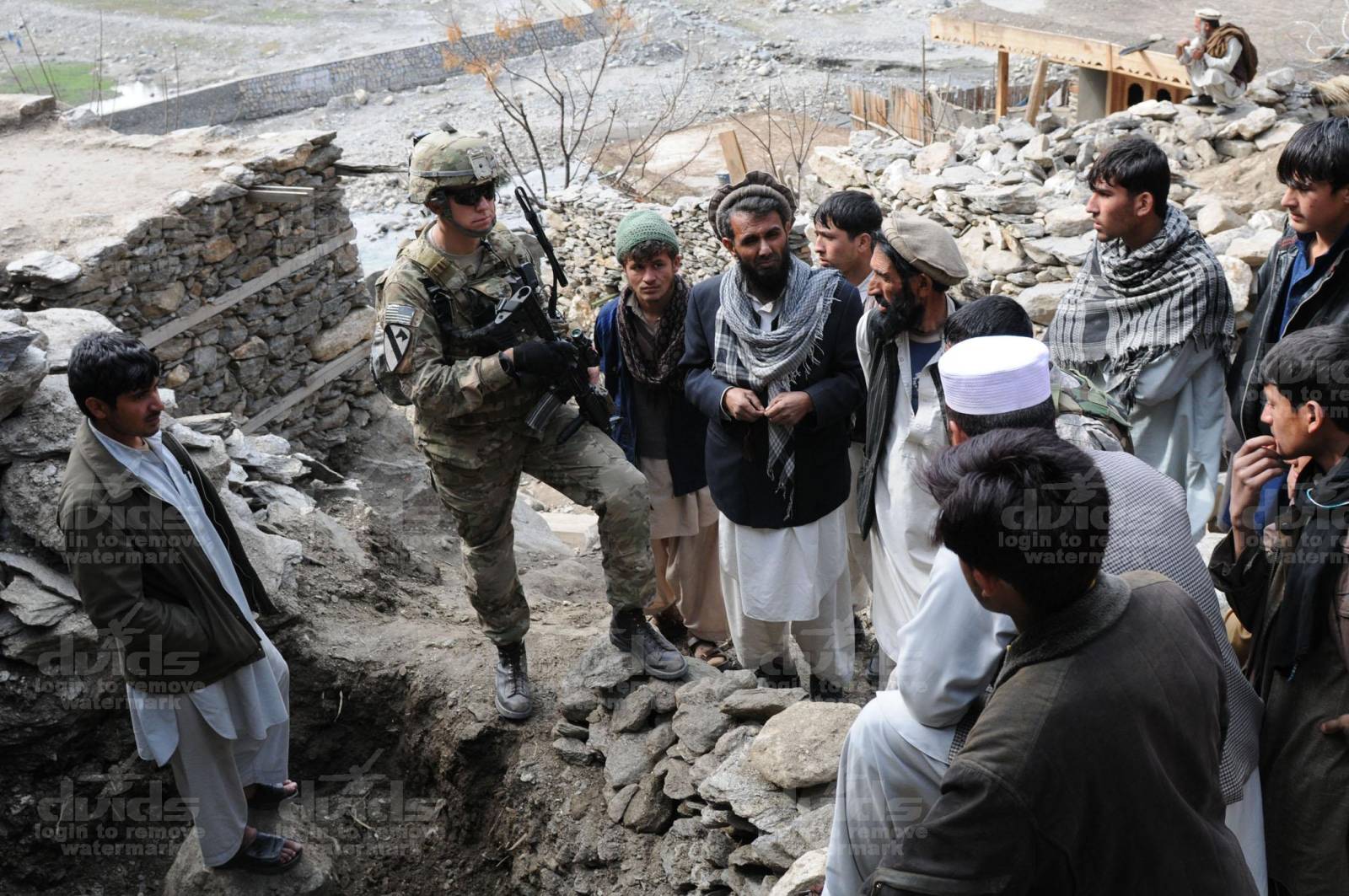 US.
Army 1st Lt. Gabriel C. Dearman of Hattiesburg, Miss., the platoon leader of 2nd
Platoon, Company D, 2nd Battalion, 12th Infantry Regiment, Task Force Lethal
Warrior, discusses future water projects with community leaders in the Kandigal
village in eastern Afghanistan's Kunar province, Feb. 13. The International
Security Assistance Force is dedicated to helping
US.
Army 1st Lt. Gabriel C. Dearman of Hattiesburg, Miss., the platoon leader of 2nd
Platoon, Company D, 2nd Battalion, 12th Infantry Regiment, Task Force Lethal
Warrior, discusses future water projects with community leaders in the Kandigal
village in eastern Afghanistan's Kunar province, Feb. 13. The International
Security Assistance Force is dedicated to helping
1 of 6
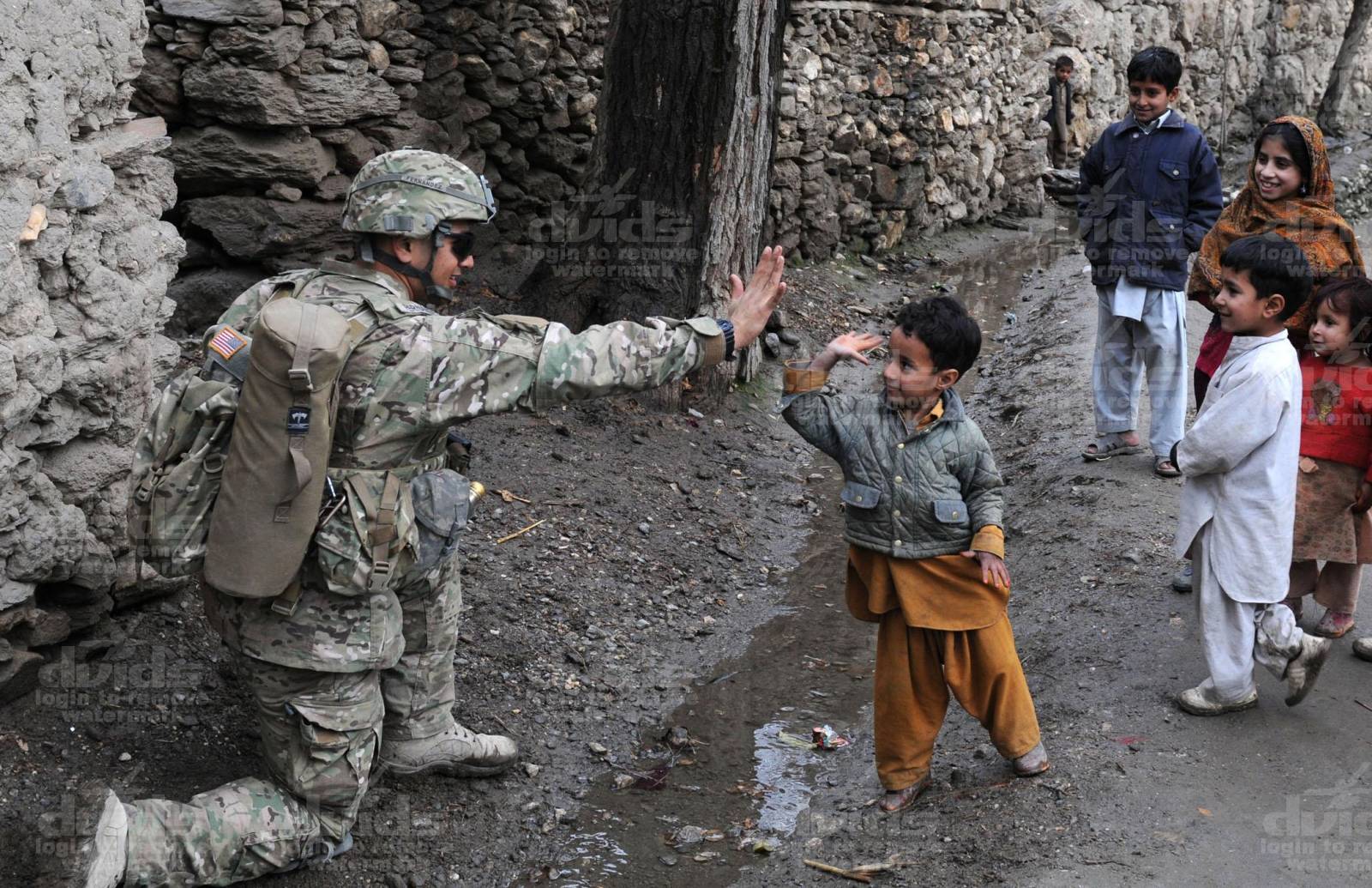 A
child from the Angla Kala village in eastern Afghanistan’'s Kunar province,
gives a high five to U.S. Army Spc. Jesus B. Fernandez, of San Jose, Calif., an
assistant team leader with 3rd Platoon, Company C, 2nd Battalion, 12th Infantry
Regiment, Task Force Lethal, during a unit visit, Feb. 6. International Security
Assistance Force troops regularly meet with village elders to improve
communications between residents and government officials.
A
child from the Angla Kala village in eastern Afghanistan’'s Kunar province,
gives a high five to U.S. Army Spc. Jesus B. Fernandez, of San Jose, Calif., an
assistant team leader with 3rd Platoon, Company C, 2nd Battalion, 12th Infantry
Regiment, Task Force Lethal, during a unit visit, Feb. 6. International Security
Assistance Force troops regularly meet with village elders to improve
communications between residents and government officials.
2 of 6
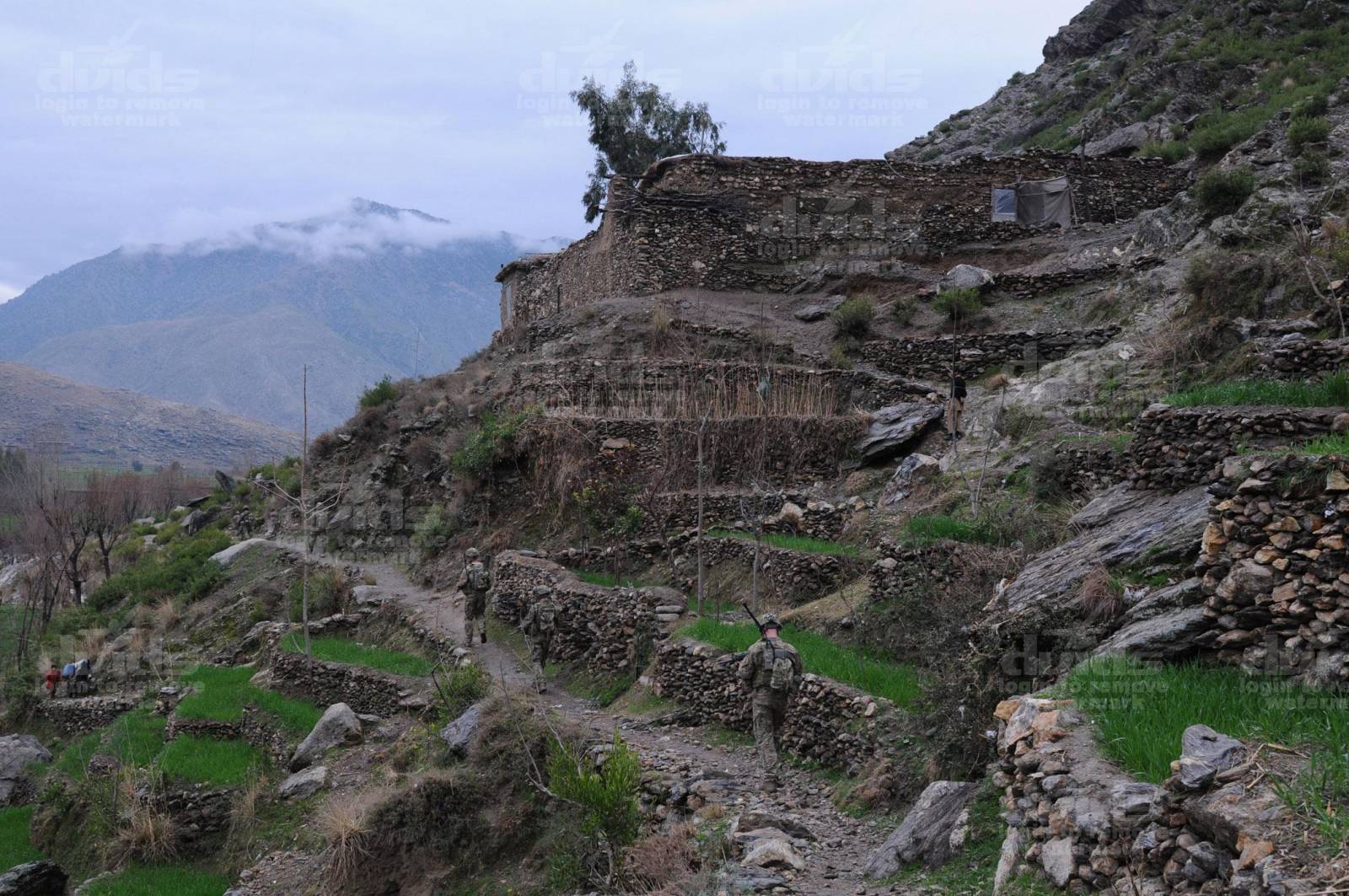 U.S.
Army Soldiers from 3rd Platoon, Company C, 2nd Battalion, 12th Infantry
Regiment, Task Force Lethal, return from a visit to the Angla Kala village in
eastern Afghanistan's Kunar province, Feb. 6. International Security Assistance
Force troops regularly meet with village elders to improve communications
between residents and government officials.
U.S.
Army Soldiers from 3rd Platoon, Company C, 2nd Battalion, 12th Infantry
Regiment, Task Force Lethal, return from a visit to the Angla Kala village in
eastern Afghanistan's Kunar province, Feb. 6. International Security Assistance
Force troops regularly meet with village elders to improve communications
between residents and government officials.
3 of 6
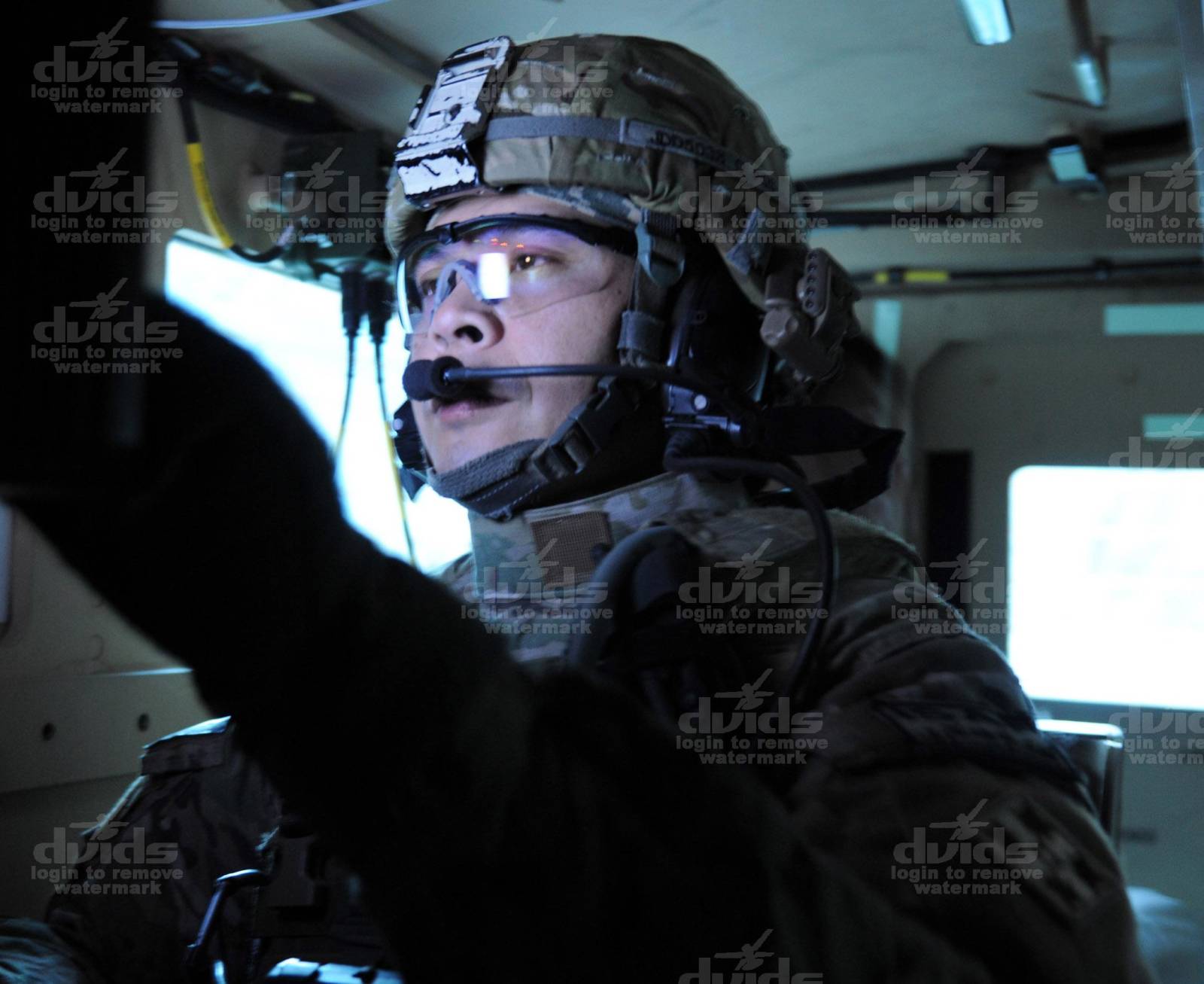 U.S
Army Spc. Alan S. Dequilla, of Bremerton, Wash., with 2nd Platoon, Company D,
2nd Battalion, 12th Infantry Regiment, Task Force Lethal, fine tunes his
Controlled Remote Operated Weapons system for an early evening patrol in the
Kandigal village in eastern Afghanistan's Kunar province, Feb. 13. The unit,
operating with the Afghan National Army, spoke with local leaders concerning
upcoming
U.S
Army Spc. Alan S. Dequilla, of Bremerton, Wash., with 2nd Platoon, Company D,
2nd Battalion, 12th Infantry Regiment, Task Force Lethal, fine tunes his
Controlled Remote Operated Weapons system for an early evening patrol in the
Kandigal village in eastern Afghanistan's Kunar province, Feb. 13. The unit,
operating with the Afghan National Army, spoke with local leaders concerning
upcoming
4 of 6
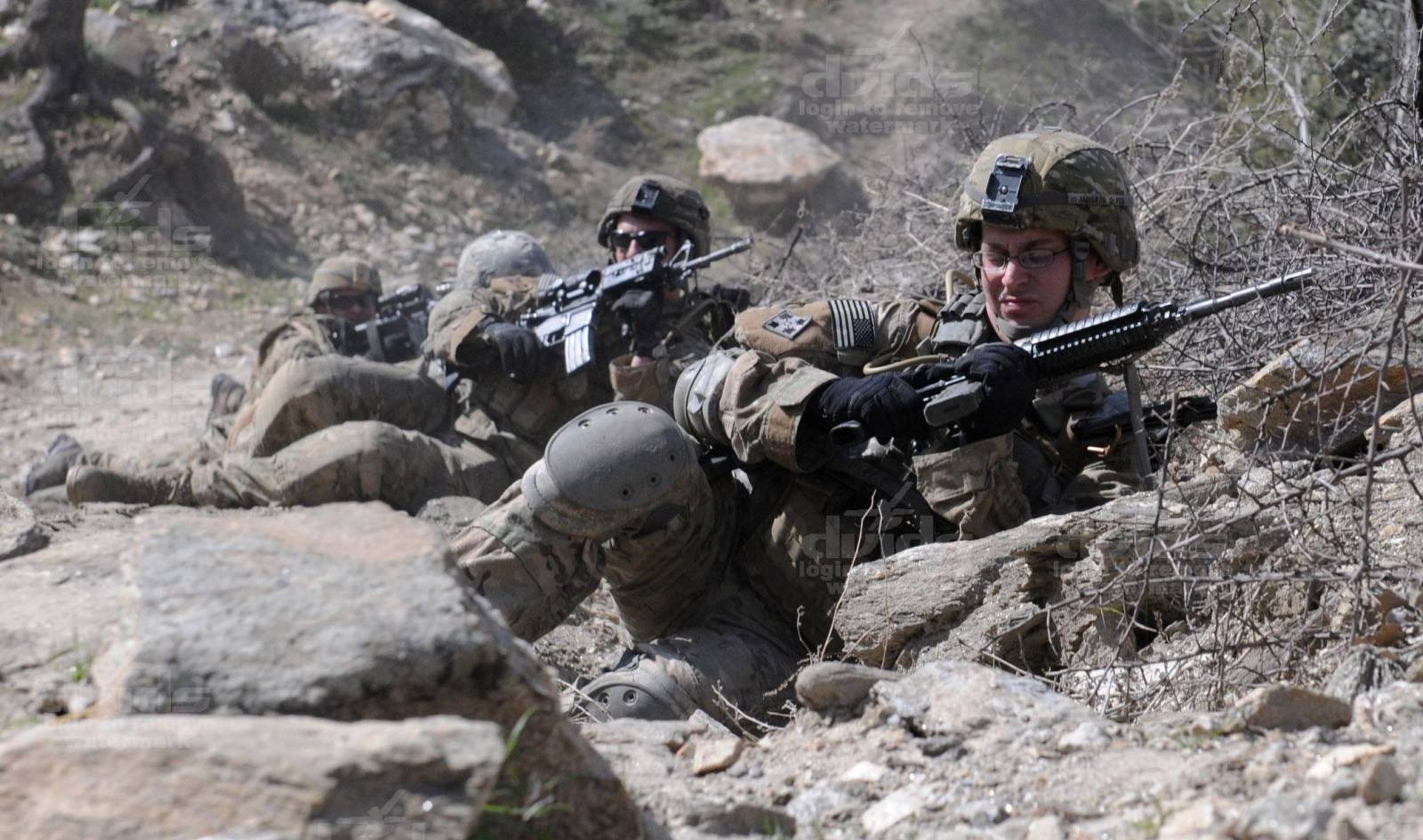 U.S. Army 2nd Lt. Robert J. De Young of Atlanta, Ga., the incoming platoon
leader of 2nd Platoon, Company D, 2nd Battalion, 12th infantry Regiment, Task
Force Lethal, reloads during an attack by insurgent forces in the Tantil Village
in eastern Afghanistan's Kunar province, March 13. Afghan national security
forces and International Security Assistance Forces visited the community and
its elders because of a high number of recent militant attacks in the area. No
ANSF or ISAF members were wounded during the small-arms attack.
U.S. Army 2nd Lt. Robert J. De Young of Atlanta, Ga., the incoming platoon
leader of 2nd Platoon, Company D, 2nd Battalion, 12th infantry Regiment, Task
Force Lethal, reloads during an attack by insurgent forces in the Tantil Village
in eastern Afghanistan's Kunar province, March 13. Afghan national security
forces and International Security Assistance Forces visited the community and
its elders because of a high number of recent militant attacks in the area. No
ANSF or ISAF members were wounded during the small-arms attack.
5of 6
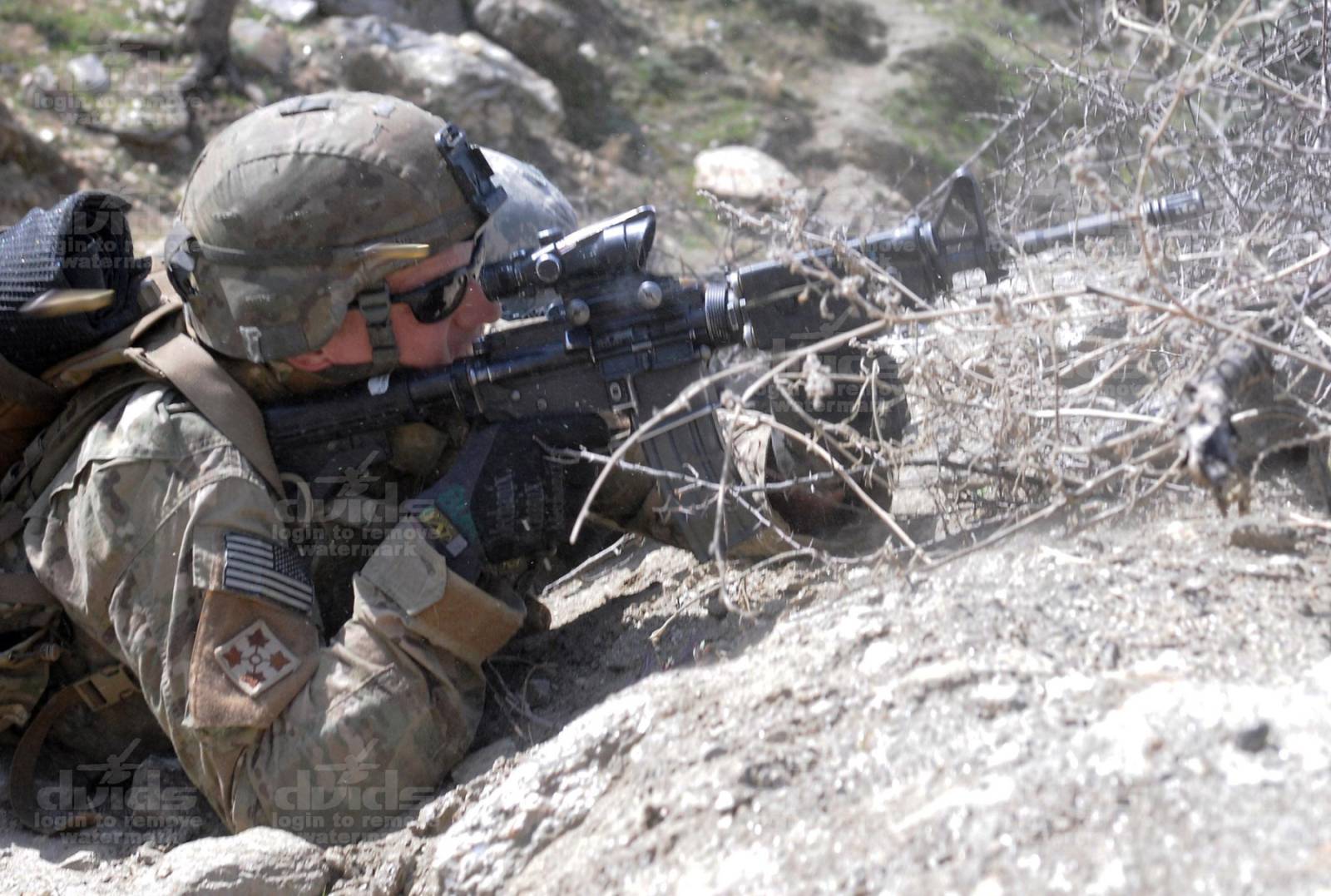 U.S.
Army Pfc. Robert Goggins, of Bay St. Louis, Mo., a gunner with 2nd Platoon,
Company D, 2nd Battalion, 12th Infantry Regiment, Task Force Lethal, returns
fire after his patrol was attacked by insurgent forces near the Tantil Village
in eastern Afghanistan's Kunar province, March 13. Afghan national security
forces and International Security Assistance Forces visited the community and
its elders because of a high number of recent militant attacks in the area. No
ANSF or ISAF members were wounded during the small arms attack.
U.S.
Army Pfc. Robert Goggins, of Bay St. Louis, Mo., a gunner with 2nd Platoon,
Company D, 2nd Battalion, 12th Infantry Regiment, Task Force Lethal, returns
fire after his patrol was attacked by insurgent forces near the Tantil Village
in eastern Afghanistan's Kunar province, March 13. Afghan national security
forces and International Security Assistance Forces visited the community and
its elders because of a high number of recent militant attacks in the area. No
ANSF or ISAF members were wounded during the small arms attack.
6 of 6